Polycarboxylate Dispersants for Calcium Sulfate Hemihydrate Systems
Defines a PCE comb-polymer architecture specifically tuned for the calcium sulfate hemihydrate / dihydrate equilibrium.
- Assignee
- BASF Construction Polymers
- Jurisdiction
- United States
- Filed
- 2003-05-27
- Published
- 2008-03-04
- Status
- Granted
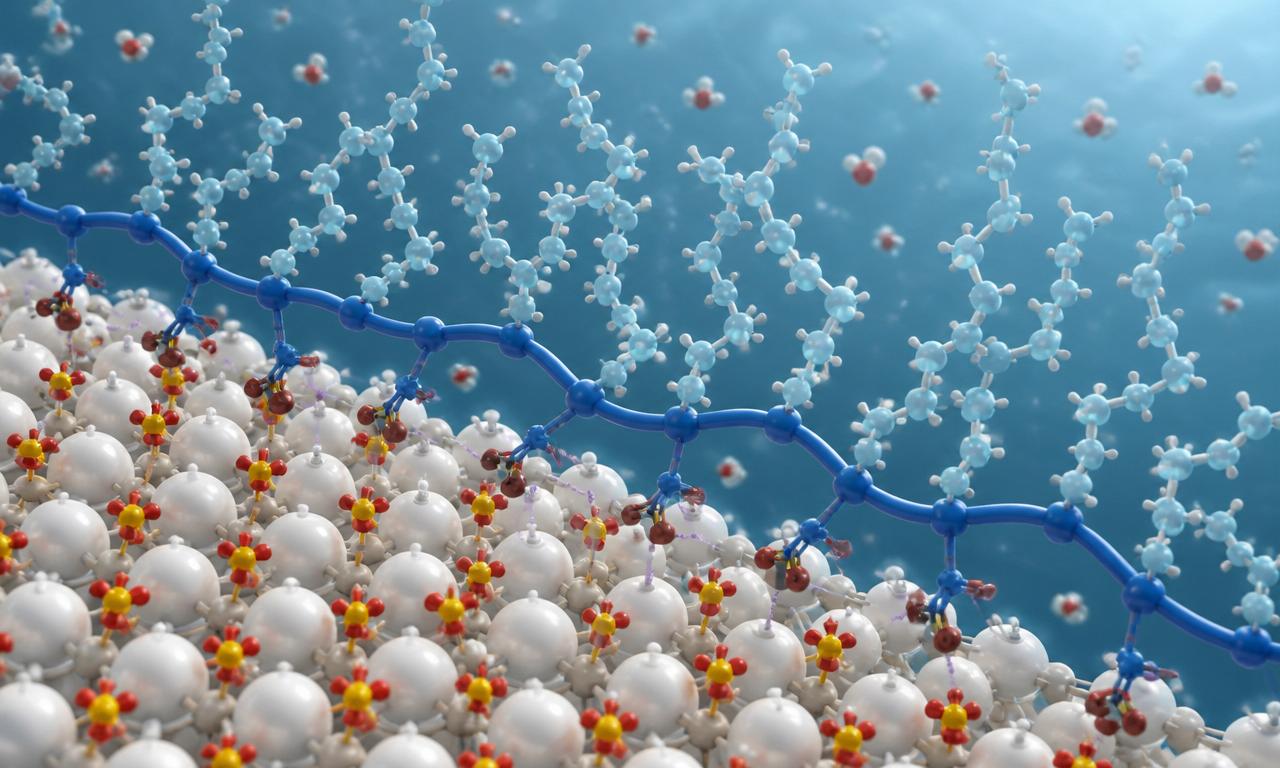
Discloses an anionic carboxylate backbone grafted with polyethylene oxide side chains of defined length and density, optimized for adsorption on hemihydrate surfaces. Provides 25–35% water reduction at typical board-line slurry temperatures without unacceptable extension of the induction period.
Every kilogram of free water carried into the kiln is roughly 2,260 kJ of evaporation cost. A 30% water reduction is one of the largest standing energy levers in the gypsum industry. The patent gives the architectural parameters that make the comb work for our specific calcium chemistry — most cement PCEs do not translate one-to-one.
- Claim 1
Side-chain length (mol EO) range and grafting density window for hemihydrate compatibility.
- Claim 2
Backbone charge density window — too high and adsorption is irreversible, causing dispersion failure; too low and water reduction is insufficient.
- Claim 3
Co-additive accelerator system needed to compensate for the PCE-extended induction period.
A new PCE almost always requires a re-tune of your accelerator. If you swap dispersant chemistry and start seeing edge crumbling at the knife, your initial set has been pushed past the cut. The fix is accelerator dosage, not more dispersant.
- · USPTO Patent Full-Text Database, US 7,338,990 B2
- · BASF Construction Polymers product literature, Melflux series